Sunday, 12 October 2014

Blog post 3

Character Profile
We began the week by creating our character profiles in note form; my basic acknowledgements of Rachel is that she is confident, loud, fiery and not afraid to be individual. She protests for what she believes in which at the time is student fees.
We then went on to explore into the different relationships that Rachel has with the other characters. For example;
Amir and Rachel (boyfriend and girlfriend). They have a good relationship however in some scenes it wavers. They know each other well and they also know how to tease the other and they enjoy each others company.

Workshops
Our first activity was "balancing the plate". All 18 of us stood in a circle with a water bottle as our center point. Two or three people start to create a smaller circle which is the rim of our plate. We then had to balance out the plate; whilst adding more weight to different points on the plate. This exercise got us to use teamwork between those on the plate. We had to concentrate on where the other people were stood to ensure that the plate wasn't unbalanced. This could be used for some scenes in '13' as it keeps the scene interesting and moving instead of static. Stories can be told from just the movement of circling each other such as confrontation or an disagreement. This could be used in one of the scenes with Rachel and Amir because the circling could represent looking out for one another and the circle of the plate meaning infinitive love and care.

We learnt about stagecraft in Principles of Acting. Stagecraft is the balance of a performance with actors.
We played around with actors being an obstacle for the others objective. We had two actors on stage and one had to stop the other from leaving the room. This gave us an insight in what bits we had to dig into for our character profiles. We had to identify our personal characters objectives in a selection of scenes and also what their obstacle is whether it be a person or a scenario that just took place ie Amir getting arrested would be an obstacle for Rachel and her objective is to find out where he is.

We then continued to develop 13...
We each had to research a certain topic related to '13', we then had to put this into a form of presentation and present it. My group, Hannah, Soph and I researched a mixture of sections. Soph decided to put this all onto a poster to make it more interesting for the audience adding images, 3-D objects and using lots of coloured pens. We researched into Mike Bartlett himself, such as the fact that he studied Theatre and English at the University of Leeds and we listed a few of his plays and his awards for these plays. We then spoke about our individual characters, talking about their characteristics. We then focussed on the political side of '13' such as the London riots, the coalition of David Cameron and Nick Clegg and the influences of Margaret Thatcher; also basing these political views around the character Ruth. We then pin pointed the three countries in geographical problems. The three being Britain, America and Iran. The religious views of '13' were then discussed, such as Christianity, Sir Christopher. I, then personally added my own views on '13' such as how I pictured '13' as a huge jigsaw puzzle with the mixtures of all the characters and then once John returns he is like the last piece to the puzzle whom then fits the play together as such. I then wrote bullet points of the themes in the play as a summary and also featured the topic of Love Actually (the film) which was used in class as similar to '13' due to the insights of the characters.

In our rehearsal session this week we covered Act One Scene Fifteen as a group (Me, Brandon, Frank, Milo and Soph.) Previously, I found this scene very static and boring as the actors, including me, were just stood speaking and not much movement was featured. However after the 'balancing the plate' exercise. I came up with the idea that we layed out our scene like the 'balancing the plate'. The scene began (as you can see in the video attached) with me and Brandon entering the stage. The circle is created by Brandon (playing Amir) rushing over to the other side of the circle when he gets frustrated with Rachel. We then slowly walk round the edge of the circle and then meet in the middle when he asks me "is he ok?". We do this because it shows that we care about John and finally agree on helping him. The scene continues in the plate effect as John and Mark enter and meet in the middle when they have their own two-way conversation. However, when Shannon enters, out of breath and in a hurry the circle explodes outwardly as though she has just jumped on the plate making it jump too. At the end of the scene, as John leaves Rachel and Amir stand together on the right side of the stage as John exits from the left side. Shouting his last few lines as he goes. When we showed this to Karen she helped us neaten it up but apart from that she really liked it. I felt so pleased with myself because I managed to change the scene that I disliked to one of my favourites, partly knowing because it was my idea but because its now more interesting for the audience as they have plenty of things to be watching.

Frantic Assembly review

Frantic Assembly ‘Lovesong’ and 'Stockholm' review

In this review I will be comparing two Frantic Assembly pieces, ‘Stockholm’ and ‘Lovesong’.  Frantic (Assembly) are a well-known Physical Theatre company; and two of their popular pieces are ‘Stockholm’ and ‘Lovesong’.

‘Lovesong’ is a contemporary style play which runs along the theme of a couple in love. The story intertwines both the young version, of the same couple, and the old version with the resurrection of past memories. This piece is deeply emotional and pulls at all your heart strings. It makes you believe in real love and it lasting, which is showed through the different ages of the couple. I think, nowadays, that it’s so rare for a couple to stay together for so long and this is where Frantic wins because, watching ‘Lovesong’ shows you that love does still exist. I believe Frantic created a love themed piece to catch out those who perhaps don’t believe in true love, and if you were to watch it (which I highly recommend) you will be, emotionally changed.

Another strong theme in the, “achingly beautiful”piece (The Independent), is death, which of course is inevitable. Frantic portray death as a very casual subject in the younger version of the couples. It then becomes more and more serious, especially for the old man, as he watches his wife slip away from him with the help of a large quantity of medication. I think that the lady sees it as just keeping herself well, in a way, but the audience are portrayed as knowing better than her as we all understand the issues of overdosing. This style of  acting is similar to those of the Greek Theatre/Tragedy as, in these plays the audiences were often posed with difficult decisions or treated as though they understand more than those who are on stage.

My love for ‘Lovesong’ comes from the clever overlap of time between the couples age ranges, with the subject of the skull. The skull is given to young Bill as a gift from his newly wed wife, and then flowing straight into a scene in which the elderly are clearing the loft and only to discover the same skull they then begin to reminisce the scenario of receiving it. I adore the cleverness of the overlaps because I see it as though, life never stops and then continues to a better part, it just keeps going and you just have to treasure what the good bits and learn from the bad. Which is what I see Frantic trying to interpret through the overlaps in the piece.


‘Stockholm’ is also a contemporary styled play which is energetic and comedic. The themes are similar to ‘Lovesong’; love, emotion, abuse and jealousy. The story is about a young couple who firstly appear deeply in love, which then turns out to be an abusive and difficult relationship. The beginning of the play shows a young, rude and sexual relationship. We then see things turn. In this play, for certain, Frantic are trying to put across a message to the audience about abusive relationships and perhaps how to identify one if need be. As an audience member, the use of the knives always being on set(situated along the wall) told me that this relationship has its ‘ups and downs’ like the point of a knife does. A knife is then used in an intense and heated sequence which, for me, foresees the abuse in the relationship. The intensity between the two characters (Kali and Todd) only appears in the knife scene which to me tells me that their ‘downs’ in the relationship are less frequent but still fierce.

Frantic were influenced by Stockholm syndrome for this play. (A syndrome in which you create a bond with someone, good or bad, and don’t want to leave or escape) Frantic quoted “it was obviously the domestic situation we were interested in here.” This is showed through the fact that Kali never leaves Todd because of the bond formed between them both; even though it is an abusive relationship. “Frantic Assembly comes together like a perfectly designed; flat-pack” (The Guardian) From this I can see that Frantics ‘Stockholm’ message about abusive relationships was very clearly told such as a well-designed flat-pack would be set up.

My favourite part of ‘Stockholm’ is the knife scene/sequence. I love this scene because the atmosphere in the audience is so tense as well as the one on stage. It is very quick paced and breath taking as the knife skims past the skins of the other beautifully. This stage craft, as you would expect, takes a lot of time and a huge amount of practise to deliver it perfectly; just like the perfect flat pack.

Overall, we can see that both pieces are very similar as they both tell a story from the past in the present moment, using different effects of flash backs (a way in which they can tell the audience that this is in the past.) They both are equally emotional but in different ways, ‘Lovesong’ being because of death and happiness of a long lasting love and ‘Stockholm’ being because of an abusive and difficult relationship. And lastly, they both revolve around the themes of Love and Relationships which nowadays, I think, are taken for granted which is why Frantic try to teach us that they shouldn’t be and should be treasured for as long as possible.

I highly recommend watching both of these pieces because they are both truly beautiful to watch in both similar and un- similar ways.

Thursday, 9 October 2014

Objectives/Obstacles and "I You" activites

Rachel’s objectives and obstacles:

Rachel’s first scene, Act 1 Scene Eight, is the scene which she is phoning the police station, querying about her boyfriend whose just been arrested. John then enters, who has been missing for years, the roller-coaster of emotions of this scene is overwhelming for Rachel which results in slapping John then hugging him.
Rachel’s objectives in the phone call are simply to find out where Amir is. “All I want to know is where he is, and you’re going to find that out for me, now. Yes.” The only way she can find out where he is, is by calling the police station. Her only obstacle during this phone call is the person on the other end of the phone whom from the lines, goes against anything Rachel says/ offers which only makes Rachel more angry.
Then John enters. This throws Rachel completely. The shock of hearing a voice that, she secretly knows is John’s before physically seeing him, changes her emotions into confusion and shock. It then changes to pure hatred towards John because he left them with nothing but the assumption that he has dead. This anger then results in a hug which is given with some force but shows she is pleased to see him. Her objectives in this part of the scene is to show John her emotions because I get the impression that she doesn't particularly like expressing her emotions verbally. Her obstacle is John, who once again throws her life off the rails like he did once before, when he left. The practical outcome of these emotions are the slow motion effect of Rachels thoughts rushing through her head. When John says "Rachel?" Rachel is facing in the opposite direction, a diagonal to the audience. I act this with a confused scowl on my face, eyebrows joint in the center of my forehead. I drop my arms and sweep my hair as though to show that she is calming down. I raise my head and slowly sweep around 90degrees to face John, at the same time as delivering the short and snappy lines. Using long strides I reach John and say my final line then slapping him hard and aggressively. "We thought you were dead?" is delivered stuttered and with pauses, I finish this scene with a tad over-enthusiastic, tight hug fully taking John in as such, I close my eyes to show the relief to have him back after the years he'd disappeared


Another scene of Rachel’s is Act Two Scene Eight. In this scene, Rachel comes home from work and Amir is sat watching a video. Her objectives in this scene is to relax from a long day at work. Her obstacle for this is because Amir hasn’t done anything around the house such as “call about the washing machine? Or picked up the shopping?” Which means Rachel will have to do these things.
The practical outcome of this scene is all done with a slight sense of knowing each other well enough to tease one another. Rachel lists the jobs that she knows Amir hasn't done, Bartlett has written this in because it fully represents most couples. The women asking the man to do jobs that we all know he hasn't bothered to do. I deliver these lines by drawing out the syllables and each word as though Rachel is processing the answer before she even asks the question. 

“I                              You.”

In Act Two Scene Eight,
I trap you: Rachel sits down and then puts her feet up on his legs. This way Amir has to answer my questions about doing the work around the house.
I tease you: Rachel responds to John’s question about working hard with “yeah I have” she then teasingly punches Amir because he hasn’t done anything all day. Rachel teases him, showing the audience their close relationship.
I involve you: As John enters, he is taken aback by Rachel having her legs up on Amir. Rachel then involves John in conversation to save him from feeling awkward. This is also I assure you: because Rachel assures him that we still like him and that we don’t want to exclude him.
In Act 1 Scene Five, Police arrest Amir
I defend you: Rachel tries to defend Amir from being arrested by pushing off Police. Her attempt fails and ends with her being kicked.
In Act 1 Scene Fifteen, ‘balancing the plate’ scene
I avoid you: As Rachel starts to talk about how ‘they had a funeral’ for John. Rachel starts to walk around the circle and John catches her up. She avoids him by walking quicker towards Amir. 

Monday, 6 October 2014

Blog post 2

This week we looked into Greek Tragedy and the role of a chorus in Greek Theatre as well as more development on '13'.

Greek Tragedy
"A chorus is a body of people who speak the same but do not think the same" (Greek Theatre video: http://sdcstream.southdowns.ac.uk/view.aspx?id=7462~4t~V3INjBBD&from=AuthSuccess )
My drawing of the Greek Theatre layout.
The role of a chorus is to act ("A chorus has to spend a long time reacting to others") and react to things happening in the scene; and they stay on stage throughout the play. Behind the stage, is where the skene is situated and infront of it, is the audience. As we are familiar to today. In the image you can see the sketch of the skene, stage and the audience in a circular shape; this is called theatre in the round.
Greek theatre flourished in 550 BC and 220BC; it is commonly know as dark theatre with the constant theme of death. It is known to be "emotionally draining" for the audience as feelings are shared from the chorus to the audience which makes it so emotional for the audience. The reasons for this is because the chorus is the realistic interpretation, for the audience, of human tragedy and the "universal and unfairness of suffering unnecessarily" (From the link above)Greek Tragedy also covers
the aspects of human life such as;
Angry Greek Tragedy mask worn in the Greek plays.

  • Love
  • War
  • Sacrifice
  • Fear
  • Death
  • Religion
  • Politics
  • Truth
And it was the choruses role to make sense of what's happening on in the scene, pick up on any emotions and tell it to the audience. 

Masks were worn in Greek Tragedy mainly because scenes performed on the Greek stages were often going against (making fun) those higher up i.e Gods. That meant that the masks acted as a privacy boundary for the actors who were recreating scenes that they perhaps shouldnt be. Masks were also worn because they were a part of a religious tradition; and it also enabled the actors to become different characters throughout the play as they could simply just change masks or for a man to play a woman etc.

Public Scene in which we act as a chorus.
We experimented with the role of a chorus in Stephens speech in Act 1. The scene before this one is a protesting scene in which Amir gets arrested and Rachel beaten up. This scene flows straight into the speech scene as all the other actors (excluding Stephen) slowly turn into students in the speech/lecture. Those who turn from protestors to students are the chorus in '13' as we show the scene change into a lecture; which is what the chorus's role is to show whats' happening on stage. As you can see in the image, we have people in the background reacting to things happening on stage. The strengths of this scene is the clever change over from protesters to students; as this represents teenagers/students being rebellious and difficult but when something interests them, the attention is turned. The students begin to listen to Stephen as though they are drawn to him and what he has to say. This could be a reference to schooling in the UK. Students are perhaps being taught the right things but not in the right way to reach them fully and engage them and their beliefs and their interests. So we created this scene to which some students really take an interest in the speech, and others who don't, similarly to a ordinary class. Another strength is the way Luke plays Stephen, his voice is performed soft but informative and I find myself genuinely interested in what he is saying because of this. He uses the circle of students to walk around and interact with each of us students. 
The weakness of this scene is that Stephen is caged in by the ring of students; I feel that if he had room to escape the circle and then continue the speech directly to audience as though they are also students; which means the audience, as I did, can really focus on him and take in what he says, as its key to the scene, the students in the circle can continue to look up on the box, where Stephen originally stands as though he is still stood there. I think with Stephen in the circle of students the entire scene excludes the audience but letting him outside the ring helps to engage the audience before they lose concentration. 


'13'
We looked deeper into '13' this week. We talked about the style, which we settled on a contemporary style. We talked about the issues that appear in the play such as politically, economically, geographically and culturally between Britain, America and Iran (in 2011). A large issue that is addressed in '13' is social media/networking. This is brought up in various parts of the play; in August 2011, the London riots began. These riots when on for days and caused chaos in the city. These riots were named the "BlackBerry riots" because social media helped them organise the riots such as when and where etc. However, Bartlett uses social media in a positive way in '13' as characters use it to 'advertise' Stephen and Ruth.

 Home research:
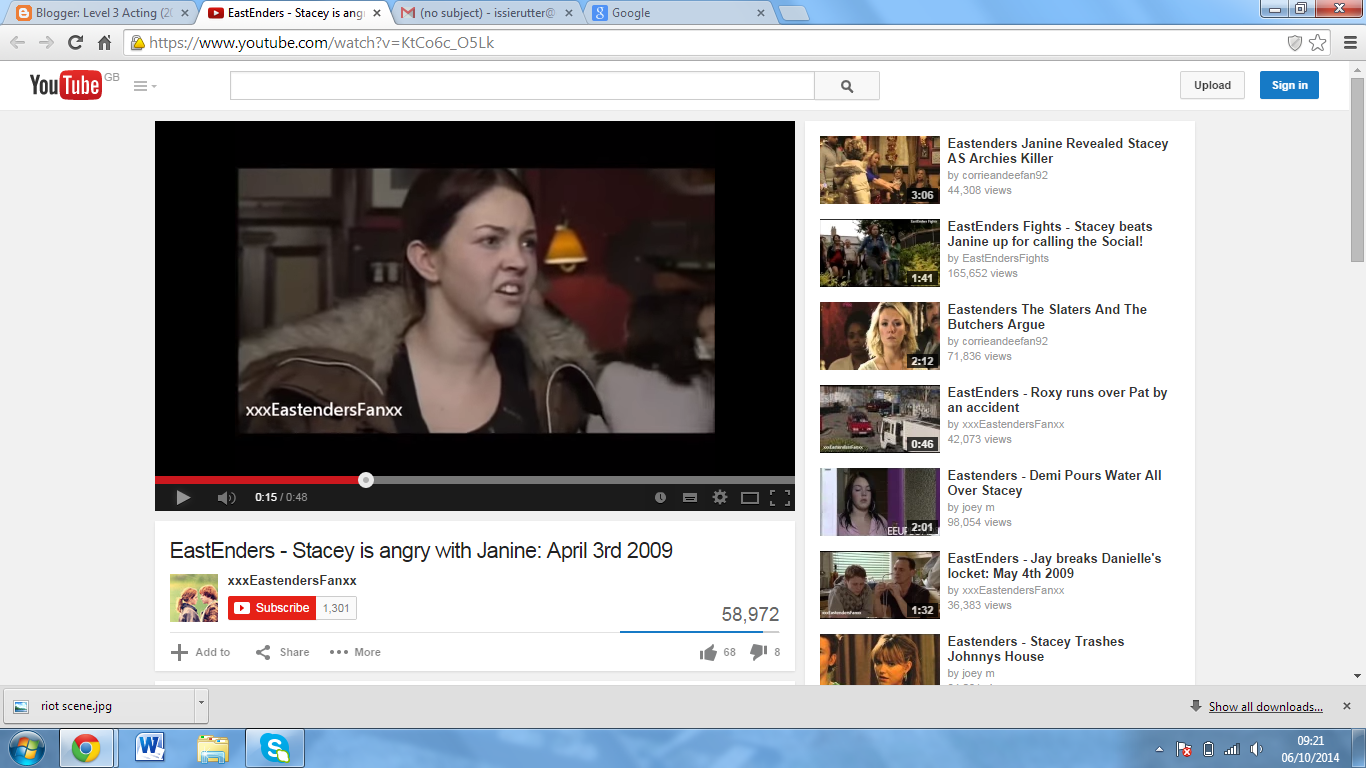
Stacey getting angry with Jeanine.
This scene was difficult for me first time round because I struggled to really release the anger that was essential for this scene. When doing it in class; I knew that I wasnt releasing the anger. I felt as though I was just acting angry but not feeling it as well. I took this scene home to master. I then researched Eastenders angry scenes to help me; as I could get ideas from the actors. I found a clip on YouTube, this clip is of Stacey getting angry with another character. From watching this video,I found that even though Stacey asks Phil a question, she does'nt give him any time to answer. Bringing this back to '13', Rachel asks questions on the phone to the police station (Act 1 Scene Eight) but does'nt give them time to reply.
Web link-

We then rehearsed this scene again in class, and I felt that I accessed the angry more realistically. As I imagined something that really made me angry and expressed the anger through the lines I needed to deliver. I felt it was a lot more successful this time round especially the slap as I got the audiences reaction of slight gasps even though the audience was just classmates who knew it was coming.

Personal Aims
My personal aims for this play is to get a comment, after the show, saying "wasn't Rachel a harsh character? Or a comment, in which they talk about the character and not who plays it. This would tell me if I fully became someone else and played her so well that the audience begin to know her as 'person'; because Rachels personality is so different to mine that would mean that I did'
nt act as Issie I was a completely different. I also want to feel pleased with how I did and get constructive criticism so I know how to keep improving because I will never improve otherwise.


Saturday, 4 October 2014

Drama school research #2

LONDON ACADEMY OF MUSICAL AND DRAMTIC ART (LAMDA).
My current course is at South Downs College, Level 3 Acting Extended Diploma Btec.
The grades that I have are;
·         English Language B
·         English Literature B
·         Mathematics D (in progress)
·         Science Additional E
·         Science C
·         French C
·         Business and Communications A
·         Ethics and Philsophy C
·         Geography C
·         Drama C
·         Media (Btec) D*

Modules covered in college so far;
Stanislavski, Anton Chekhov, Physical Theatre (Frantic Assembly)

Extra-Curricular activities related to Drama- Merchistoun Hall Youth Arts (MHYA) is an out of ‘school’ drama club. Joined August 2013.
The skills that I have are organised, confident, reliable, polite, approachable.
Skills, qualities and experience I’ve yet to gain are; a attitude ‘teacher-like’, strict, to-the-point, experience in teaching and working with children.

How do I get there?
LAMDA: Drama school
BA (Hons) Professional Acting- Three year course

LAMDA will help me develop my skills in; Acting, improvisation, voice, movement, singing, textual analysis, Alexander Technique, physical theatre, stage combat and dance for the first year.
In the second year at LAMDA students take part in a Make Your Own Film module. Students get to work with a professional writer and director to create a short film; and in the final year students get to complete the final stage of acting, voice-over and microphone training. They also record a radio play, a professional voice reel and continue to improve their on-camera technique. Students train for a minimum of 35 hours per week and all classes are compulsory.

Finance options:
For UK students LAMDA is £9,000 per year. So for the three years acting course the costs would be: £27,000. UK students are also eligible for financial support (LAMDAs scholarships scheme).
LAMDA doesn’t have its own student halls of residence; but they do provide students with information on finding accommodation in the enrolment packs.  

Skills are requirements to get in:
I am predicted a C in Mathematics and I hope to receive distinctions in my college Btec course. There are no academic requirements for LAMDA apart from students must be able to speak English.
The application takes place online and is at a cost of £49 for UK students, there is no cost for auditions but students are required to attend audition within two/three weeks of notice.

Why is this course for me?
LAMDA provides me with the skills and the different types of acting. As well as teaching about theatre acting they also focus a lot on TV acting, physical theatre and radio which is interesting for me as I want to experience different forms of theatre and acting.
My current skills relate to experience in radio; as at school we had the opportunity to create our own radio station. So I can go into this course with my original knowledge and understanding of radio and excel on this to understand it fully. I've done small roles of film acting but I have only been taught in theatre acting so I would it would be interesting to experience film acting fully which LAMDA can help me do so. 
     All this previous experience and ones that I will continue to learn or learn at LAMDA will help me to fully understand each and every element of acting covering the entire aspects of it to help me become a knowledgeable actor, allowing me to begin to audition for theatre, TV, film, radio and even musicals. n my second year at college we will cover film and radio which will also help me to enter LAMDA with some knowledge to present and extend on. 

The location (London) is negative for me, as accommodation in London is expensive as well as the fees for university on top of that.
The alumni of LAMDA:
·         Sam Claflin – Finnick from Hunger Games
·         Dominic Cooper – Momma Mia
·         Benedict Cumberbatch – Sherlock Holmes
·         Patricia Hodge – Miranda
These are a few of the very successful actors that studied at LAMDA.

Finanically LAMDA is a struggle as it’s a three year course, which of course triples the price. 

Post-training:

There would be no need for further training after LAMDA just auditions for a further job career in theatre.

Blog post 1

Introduction:
Our first play at college is called '13' by Mike Bartlett. It's a play about 12 people who all share the same dream. The thirteenth person comes back from,what the 12 thought, was dead. The play was published in 2011 and has themes of high importance such as Politics, Royalty and Religion.
(The cover of the book represents, to me, seeing the light just before going to Heaven/death and the number 13 appearing at 'the end of the tunnel'.)
                 I believe that '13' has political elements as for the obvious suggestion in being that one of the characters is a Prime Minister; so politics nearly always revolves around these characters. Ruth is a conservative politician; as was Margaret Thatcher.  Thinking outside the box, I understand that the title of the play is due to the number of characters whom are affected by the dreams; but it could also symbolize the Greek Chorus which normally consist of 12 to 15 members. The '13' represent the 'sheep-like' politicians in court who cheer and jeer in order of what is happening between the two parties (or Prime Ministers in the case of the video link). This relates back to the Greek Chorus because they react to what happens on stage; similarly to the politicians. An example of this is Act 1 Scene 13, Ruth's speech. In this scene a choral selection of actors listen and react to the things Ruth says. At times there are those who look hopeful and supportive of what she has to say, and those who look down in shame or anger. Nearing the end, those in favour of what she has offered cheer and vocally celebrate; just as the politicians do in the video. 
 https://www.youtube.com/watch?v=TsAa9VmwOaI  This video backs up my suggestions of choral reaction, to what Gordon Brown says. And a lot of the play involves ensemble and choral scenes which is how I come to the conclusion that Politics is the main theme of '13' and the other themes all work around the main one; as we all do day-to-day by obeying the laws and regulations of Prime Ministers and Politics. 


To begin with, we read through a short section of the play. By doing this, we could understand the basic storyline of the play and also the characteristics of each role. I read for Ruth in this casting workshop; Ruth is the Prime minister in the play whom is very authoritative. I enjoyed reading the part of Ruth because she was higher up than the other characters. Ruth would be a big challenge for me to play as she is strict, loud and very confident as you would expect from a Prime minister. However this is why I liked Ruth as I wanted to challenge myself and try new characters out instead of being type-casted as a polite and quiet character; which isn't pushing me out of my comfort zone.

Exploring the character of Rachel:
I  expressed my opinions to Karen who then gave me the chance to read for Rachel. Rachel is a young, loud, confident protester. She is very quick with words and extremely feisty. When reading Rachel, I discovered that she is quite a comical character as she says and acts just as anyone would; meaning that the audience can relate to her because she is someone so realistic to them. Rachel is a character nothing like ones I've played before; and she would be a challenge for me to play because she is so loud. But I wanted to challenge myself and see what I can do...
Image of Amir and Rachel. Boyfriend and Girlfriend.


In this image, you can see that Rachel (with Amir, her boyfriend) She is  wearing an ordinary dress with a pattern on. However, this is not how I wanted Rachel to dress in our performance. I had imagined her to be wearing a more hippie-like outfit. For example, skinny jeans with boots. A baggy top with a long cardigan (thin material and perhaps a camouflaged look) Plenty of necklaces, bracelets and anklets, maybe even a bandanna.The look I am trying to get is like in the second image, the girl third from the left.

Group of Festival-like dressers.Influence for the costume of Rachel.
I want to experiment with this style of clothing because Rachel strikes me as a hippy whom likes to be out of trend/fashion and who likes to be individual with both her clothing and her opinions. I know from other costumes in the show,that I've researched, that Rachel will be very differently dressed from the other characters which is exactly her personality. I want her to stand out.I imagine her to always have her bag on her as well, as though she's ready for anything; her being so quick to react to anything and everything. However Amir, from what I know isn't that similar to Rachel which makes me wonder why Rachel, being so individual,would date someone who might not appear out of the ordinary. I think it could be because Rachel is trying to fit in; which then leaves me in the predicament of what sort of clothes does she wear?

Development on stage:
The majority of lines that Rachel says, in Act 1 so far, are expressed through a range of emotions. For example in Act 1 Scene Eight, Rachel is on the phone, extremely angry and shouting. The anger almost imedietly resolves itself when she hears the voice of John, who she thought was dead. This shows us the relationship that Rachel and John once had. I get the idea that Rachel and John once had a close relationship of just friends; but perhaps one of them (I'm not sure who) wanted more than just a friendship? The pure shock and confusion is demonstrated through the amount of pauses Bartlett includes in the next three short and snappy lines Rachel delivers. "Oh god...God...John?...How can?..." She then runs and slaps John. This is, to me,  Rachels way of really showing John what she's feeling. As though she doesn't like to express her feelings out loud. When me and Frank (playing John) act this scene out, after the stage slap, John responds in an unnatural way for just being slapped. He stands as though he expected it from her. By doing this, we really show the relationship that they perhaps used to have before John left because, perhaps John knew her reaction would be similar to this. Rachel then hugs John which again shows John and the audience that she doesn't express her feelings verbally but more physically.

Me and Frank playing Rachel and John. 
Another one of Rachels and Johns scene is Act 1 Scene Ten, in this scene Rachel approaches John, who is expecting her, they have a one-sided heated discussion. In our personal blocking time, me and Frank ran through this scene with just the simplicity of two chairs. Rachel standing and looking down on John and pacing in her anger. This idea was changed dramatically to a large block acting as our two chairs. We then take it in turns to move to different sitting positions on the block. For example when Rachel faces left, John has his back to hers. This way we can show the audience John and Rachels relationship between each other, and by showing that they never agree; so they are always facing away at various times in the scene.
This image shows you the block used for this scene, and it also shows you the positioning of both characters representing there not so close relationship.


Workshop sessions:
Basing our workshops on the work of Frantic Assembly, a Physical Theatre company,we tried out some relays in lessons. In groups we ran to the other side of the theatre and back again. This made us competitive in the different groups and made us work together as a team to win each relay. Following the relays, we then had to create a short story using the idea of the relays. My group created it into a war front. I came up with the idea of the three girls using Physical Theatre to make a gun, at the far left side of the stage. The three boys, in slow motion, stood up. Back to normal speed, ran the 'relay track' until the 'gun' shot them down. One solider fell to the floor very dance-like to represent the cowardness of not wanting to die; he was the last out of the three to be killed. This workshop had us narrow our thoughts as we had to relate it to the relays in some way.

These are some other workshops we tried out;


  • Chair Duets: We experimented with another of Frantic Assembly's workshops, the chair duets. These are between two people on chairs. Using three moves per person, you can move your hands, heads and bodies to create a sequence taking it in turns to move. We used some of these chair duets in a public scene (read on) This video is a Frantic Assembly inspired video of some A-level students chair duets. https://www.youtube.com/watch?v=UJ_9Eaog2yw
  • Push, Pull, Swerve and Duck: For this we created a short sequence including a push, pull, swerve and a duck. These alone create they're own story basing on the speed the sequence is performed in. 
  •  Home: This activity was done with four groups. We all had our own home (one corner of the theatre) we then had to walk together like a shaul of fish to four different points in the room. 
  • My drawing of the Keypad workshop. 
  • The Keypad: In a cluster and only using our heads, we all looked in different directions according to the the location the number on a keypad would be. Watching this from the audiences perspective, it is very effective and looks well rehearsed. The image is my drawing of the Keypad to help me remeber the activity. It shows the cluster moving their heads to the three different numbers. 

All three of these activities we tried out are used in a street scene between Holly and Mark in '13'. This scene is on the streets and to fulfil this location other members of the cast are walking on and off stage at various intervals. Individually we recite our 'Home' sequence doing ordinary things such as using a mobile phone, listening to music or just keeping ourselves to ourselves as so many do now. In one corner we have  a pair repeating a chair duet constantly as though they are sat on an ordinary park bench. These all help to add to the bustling and unpredictability of the streets. With actors entering and exiting the stage doing different things makes the scene more interesting and lively giving the audience more to watch.


Thursday, 2 October 2014

Voice Portfolio:Vocal Chords/Organs

Vocal Chords/ Organs
The Larynx and vocal folds are known as Vocal Cords.
The Larynx is in the voice box which houses the vocal cords. The Larynx contains the vocal folds; which are situated below the Pharynx which is at the back of the throat. The overall purpose of the Larynx is swallowing, breathing and voice production. The vocal chords are two bands which are situated at the base of the larynx. When air is exhaled they vibrate allowing us to make different sounds. There is such thing as false vocal chords which do not produce sounds but they exist, as they move during swallowing to close the larynx. (Baggaley,2001,16)
You can feel your Larynx when you touch the front of your throat. The Adams apple (mostly in men) is the center of the Larynx. The Larynx is made up of mostly muscle and cartilage. The Larynx acts as protection for the vocal cords
The Pharynx is at the back of the throat, where the Epiglottis separates.

Keeping your voice healthy will also help you to use your vocal chords correctly whilst on stage. Rest the voice before performances as well as warming it up just before. This helps you to have deliver lines clearly and loudly without straining your voice. Warm drinks, as you would expect, help to warm up your voice as does honey and lemon if you feel your throat is becoming sore. 
The vocal chords and organs are the main key of speaking so looking after them is important. 

Vocal nodules can seriously affect your voice if you don't look after it correctly. Vocal nodules:  "mass of tissue that grows on the vocal folds (vocal cords).http://en.wikipedia.org/wiki/Vocal_fold_nodule The tissue rubs away at your vocal folds leading to pains in the throat and even loss of voice. 

To help keep my voice healthy I know that I need to cut down on dairy products as these can damage your voice. Cutting down on the dairy products will mean I will have a clearer voice production and it will also improve my projection. 

Vocal Folds
The vocal folds adjust the pitch and tone of the voice by changing the position and adding tension to the muscles. The voice production occurs because of vibration.
The folds are situated in the Larynx.
The folds open when breathing in and out, and are closed when holding your breath when swallowing etc.
When voice is being produced, the folds stretch like an elastic band, but then return to the original position. This tension of moving creates the different pitch and tones. A flap of cartilage known as the Epiglottis closes the airway during swallowing to prevent food entering the lungs. Sound is produced in the larynx as air passes over the vocal chords. (Baggaley,2001,16)

In the image on the right, you can see my brief drawing of the Vocal organs/chords. In the image you can see the Trachea which runs through to your lungs, the vocal folds that sit either of the Trachea. 


Male and females have different structured vocal folds. Males, with deeper voices, have thicker folds. Females have thinner folds as they usually have higher pitched voices. Children have the shortest vocal folds of all.


The deeper your voice is, the more your vocal chords vibrate and the higher your vocal tone the less vibration happens.
The first picture represents a high pitch sound being released as the folds are closer together, the second picture representing someone producing a deep sound as the vocal folds are further apart. The opening of the folds only depends on the pitch and tone of the voice escaping the throat.